
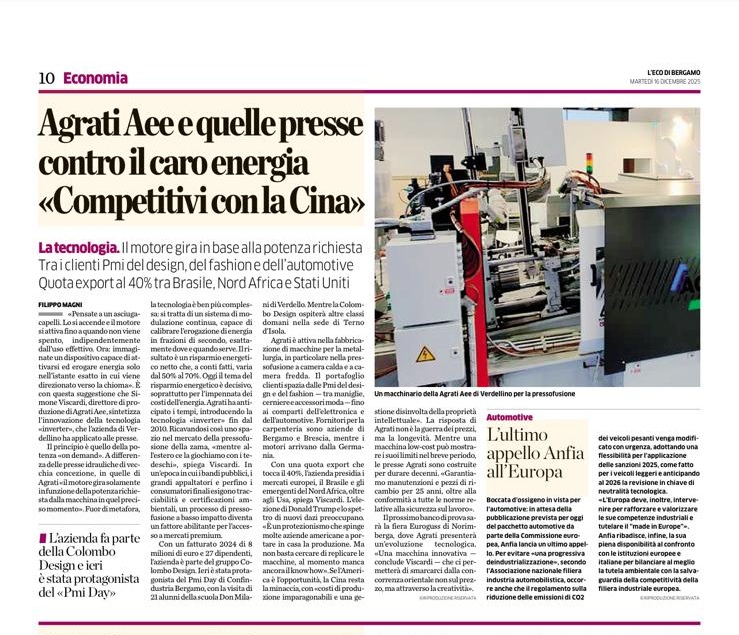
The Technology. The motor runs based on the power required. Clients include SMEs in design, fashion, and the automotive sector. Export share at 40% across Brazil, North Africa, and the United States.
“Think of a hairdryer. You switch it on, and the motor runs until it is switched off, regardless of actual use. Now: imagine a device capable of activating and dispensing energy only at the exact instant it is directed towards the hair”. This is the suggestion used by Simone Viscardi, Production Director at Agrati Aee, to summarise the innovation of the “inverter” technology that the Verdello-based company has applied to its presses.
The principle is that of “on-demand” power. Unlike old-school hydraulic presses, in Agrati’s machines, “the motor rotates solely according to the power required by the machine at that precise moment”. Metaphors aside, the technology is quite complex: it involves a continuous modulation system, capable of calibrating the energy delivery in fractions of a second, exactly where and when it is needed.
The result is a decisive energy saving, especially given the surge in energy costs. “On balance, it varies from 50% to 70%. Today the issue of energy saving is crucial”. Agrati anticipated the times, introducing “inverter” technology as early as 2010. Thus carving out a space in the die-casting market where “while abroad we play it level with the Germans,” explains Viscardi. “In Italy, large contractors and even end consumers demand traceability and environmental certification, a low-impact die-casting process becomes an enabling factor for accessing premium markets”.
With a 2024 turnover of 8 million euros and 27 employees, the company is part of the Colombo Design group. Yesterday it was a protagonist of the Confindustria Bergamo “Pmi Day”, with a visit from 21 students from the Don Milani school in Verdello. Meanwhile, Colombo Design will host other classes tomorrow at its headquarters in Terno d’Isola.
Agrati is active in the manufacturing of machines for metallurgy, specifically hot chamber and cold chamber die-casting pressure. The client portfolio ranges from design SMEs to fashion (handles, zippers, and fashion accessories) up to the electronics and automotive sectors. Suppliers for the metalwork are in Bergamo and Brescia, while the motors arrive from Germany.
With an export share reaching 40%, the company presides over European markets, Brazil, and emerging markets in North Africa, as well as the USA, explains Viscardi. The election of Donald Trump and the spectre of new tariffs are worrying. “It is a protectionism that pushes many American companies to bring production in-house. But simply replicating the machines is not enough; at the moment, the know-how is still missing”. If America is the opportunity, China remains the threat, with “incomparable production costs and a casual management of intellectual property”.
Agrati’s answer is not a price war, but longevity. While a low-cost machine might show its limits in the short term, Agrati presses are built to last for decades. “We guarantee maintenance and spare parts for 25 years, in addition to compliance with all occupational safety regulations”.
The next testing ground will be the Euroguss trade fair in Nuremberg, where Agrati will present a technological evolution. “An innovative machine – concludes Viscardi – that allows us to distance ourselves from eastern competition not on price, but through creativity”.
Scritto da Filippo Magni per L’ECO DI BERGAMO