
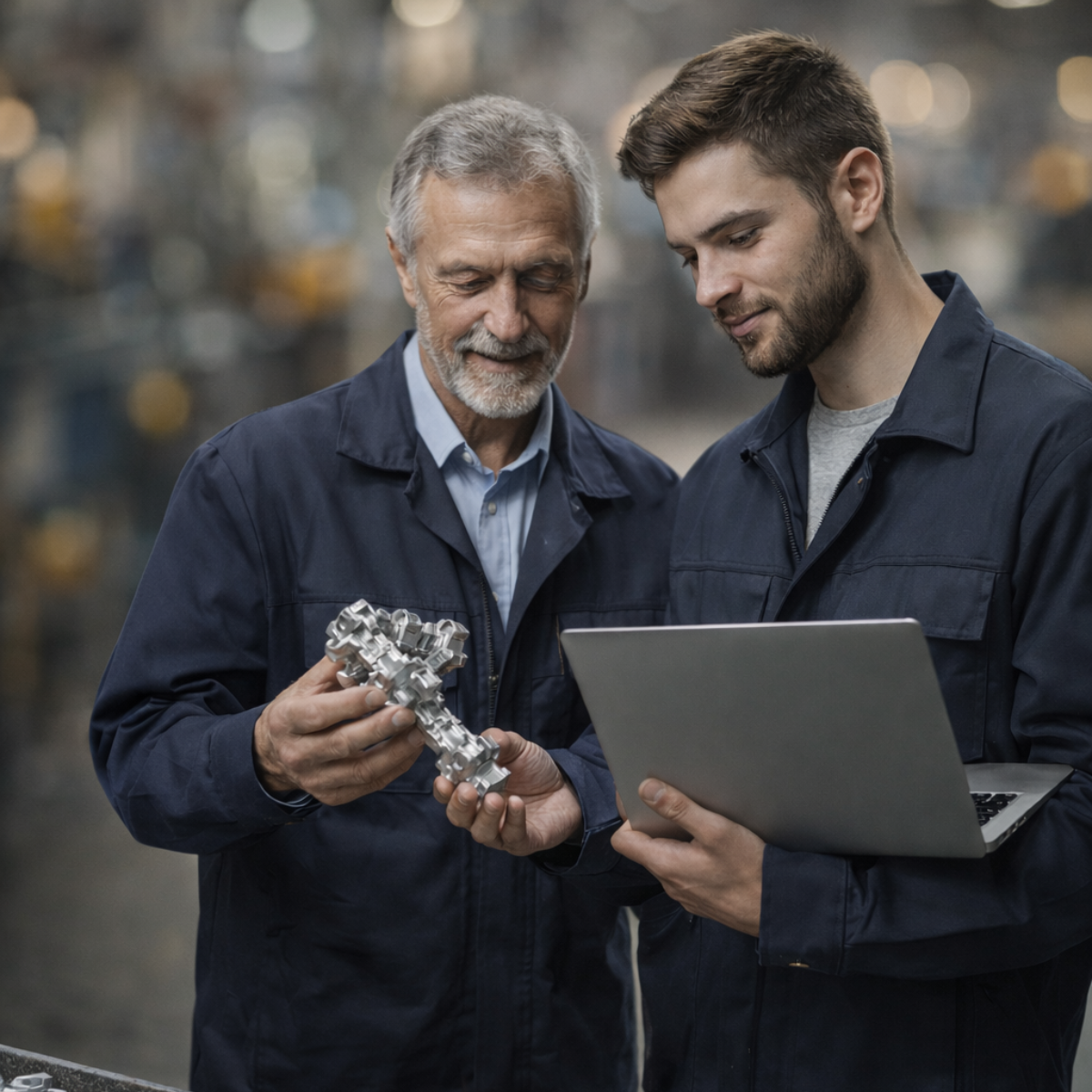
In the industrial landscape of 2026, the die-casting sector is undergoing an unprecedented transformation. While technological innovation offers increasingly high-performance machinery, such as that produced by AGRATI AEE, foundries are facing a critical bottleneck: the shortage of skilled labour.
The issue isn’t merely the difficulty in finding operators; it is the scarcity of specialised technicians capable of mastering digitised presses and next-generation quality control systems. This phenomenon is more than a logistical challenge—it is a strategic pain point threatening the operational continuity of manufacturing businesses.
The primary risk for a modern foundry is an over-reliance on a handful of experts. When technical know-how is concentrated in the minds of a few veterans, the company is exposed to significant operational hazards:
In this scenario, knowledge becomes a bottleneck. The solution lies not only in training (which is often slow and costly) but in a radical technological paradigm shift.
To lower the barrier to entry and reduce dependency on individuals, die-casting machines must become “intelligent” and communicative. The market demands a solution built on two fundamental pillars: intuitive interfaces and predictive diagnostics.
Modern HMIs must emulate the usability of the consumer devices we use daily.
If a machine is capable of “self-diagnosis,” the need for an expert constantly stationed at the machine side decreases.
At Agrati AEE, we understand that Italian technical ingenuity must serve to simplify life on the foundry floor. Our Zamak and Lead die-casting machines are designed to be the “heart” of the production cell, capable of communicating harmoniously with all peripheral equipment.
Investing in an Agrati AEE machine means choosing a system that:
The shortage of skilled labour will not disappear in the short term. However, the companies that thrive will be those adopting technologies that embed “know-how” directly into the machine’s software.
Transforming a complex machine into an accessible tool does not diminish the technician’s professionalism; rather, it liberates them from repetitive tasks, allowing them to focus on strategic supervision and process optimisation.
Is your foundry ready for the next step? Contact us to discover how our bespoke solutions can help you bridge the skills gap.